-

20+Years of Experience
-

Tele-videoConsultation Facility

-

20+ Years of Experience
-

25K+ Highly Satisfied Patients
-

99% Patient Care Satisfaction
-

State of the Art GERD Hospital
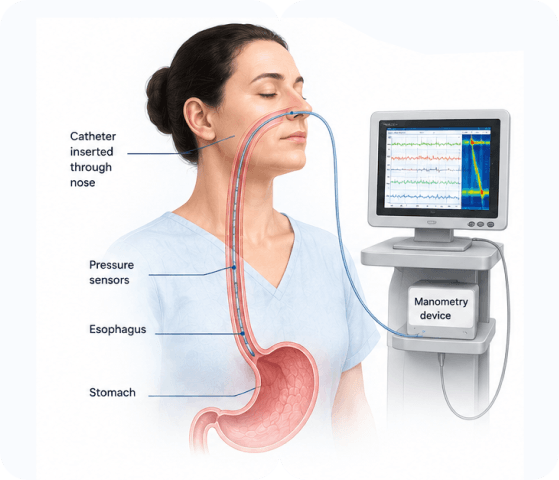
Precise Diagnosis, Confident Treatment- Advanced Esophageal Manometry at ADROIT Speciality Centre
Esophageal manometry is a specialised test that evaluates how well the muscles of your esophagus and the lower esophageal sphincter (LES) are functioning. It measures the pressure on the upper as well as lower esophageal valve and the strength, rhythm, and coordination of esophageal muscle contractions during swallowing.
Doctors often recommend this test for individuals experiencing symptoms such as difficulty or pain while swallowing, heartburn, chest pain, or regurgitation. It is also an essential part of advanced studies like 24-hour pH or pH-impedance testing, offering deeper insights into digestive health.
At ADROIT Speciality Centre, we provide world-class facilities for esophageal manometry, guided by the expertise of Dr. Chirag Thakkar, who has extensive experience in diagnosing and treating esophageal motility disorders. With precise testing and expert care, we ensure accurate diagnosis and effective treatment planning for better digestive health.
What Happens During Esophageal Manometry Testing?
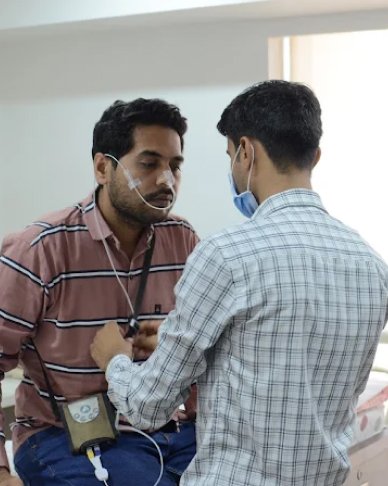
A small flexible tube called a catheter is passed through the nose, down the esophagus, and into the stomach along with sips of water. This tube has sensors located at various points to record movement and pressure. The procedure is carried out without sedation.
During the test, the patient is asked to swallow small sips of water while the tube passes through the esophagus. The patient remains fully awake and can breathe, swallow, and talk normally during the procedure. The movements and pressure changes are recorded as the patient swallows water.
The tube remains in the nose and esophagus for about 15 to 20 minutes. Patients may experience mild discomfort such as nausea, nasal irritation, watery eyes, or pressure in the nasal cavity, but the procedure is generally not painful.

Preparing for Your Esophageal Manometry Test
Before the test, it’s important to inform your doctor about all medications you are taking. Some medicines can affect esophageal pressure and muscle contractions, so your doctor may advise you to temporarily stop certain medications.
On the Day of the Test:
- Fasting: Do not eat or drink anything for 4-6 hours before the procedure.
- Anesthesia: A numbing gel or spray is applied to your nose to ease the passage of the tube.
- Procedure:
- A thin, flexible tube (about 4 mm) is gently passed through your nose into the stomach.
- The test is done while you are seated and asked to swallow small sips of water.
- The tube records pressure and muscle activity to assess swallowing and sphincter function.
- Duration: The procedure takes about 15-30 minutes.
- Comfort: Some mild discomfort, gagging, or coughing may occur, but most patients adjust quickly.
After the Test: The tube is removed, and your doctor reviews the results for accurate diagnosis.
Esophageal Manometry Testing Insights & Videos

25K+
Happy patients
Why Choose Adroit for Esophageal Manometry?
Choosing the right centre for esophageal manometry is essential for an accurate diagnosis of swallowing and esophageal motility disorders. At ADROIT Speciality Centre, we combine advanced diagnostic technology with expert interpretation to deliver precise test results and guide the most appropriate treatment.

Pioneer in Gujarat
Dr. Chirag Thakkar was among the first to introduce 24-hour pH monitoring and esophageal manometry in Gujarat, making advanced diagnostic evaluation for reflux and swallowing disorders more accessible to patients in the region

High-Volume Centre
As a high-volume centre for GERD, LPR Adroit Speciality Hospital offers streamlined testing and expert guidance.

Deep Clinical Expertise
With extensive experience in managing GERD, hiatus hernia, achalasia, and complex swallowing disorders, Dr Chirag Thakkar understands when these tests are truly needed and how to interpret them accurately for meaningful clinical decisions.

Expert medical staff
Compassionate support throughout the diagnostic journey by trained staff in a well-coordinated manner.

Dr. Chirag Thakkar
M.S., F.R.C.S. (Edinburgh, U.K), FARIS
Senior Consultant GI, Bariatric and Robotic Surgeon
Director - ADROIT Speciality Hospital, Bariatric|Digestive|Hernia surgery
Dr Chirag Thakkar specialises in Bariatric, Acid reflux, GERD, and Hernia surgery, both by Laparoscopic and Robotic methods. He is the founder director of ADROIT Speciality Hospital for Bariatric, hernia, and digestive surgery.
Have Questions or Need Assistance?
Our team is here to help. Reach out anytime for expert guidance and personalised support.
get in touch
Fill in the details below and our team will get back to you shortly!
What Our Patients Say
Hear from patients whose lives have been transformed through expert care at ADROIT Speciality Hospital.


Real Patient Experiences with Esophageal Manometry Testing
Frequently Asked Questions
Esophageal manometry is a specialised diagnostic test that measures the strength, coordination, and pressure of the esophageal muscles and lower esophageal sphincter (LES) during swallowing.
This test is recommended for patients with swallowing difficulties (dysphagia), painful swallowing (odynophagia), chronic non-cardiac chest pain, GERD symptoms, achalasia, esophageal spasms, and other esophageal motility disorders. It is also performed before anti-reflux surgery.
No. The procedure is generally not painful, although some patients may experience mild discomfort, gagging, nasal irritation, watery eyes, or pressure in the nasal cavity during the test.
The procedure usually takes around 15 to 30 minutes to complete.
Yes. Patients are usually advised not to eat or drink anything for 4-6 hours before the procedure for accurate test results.